You are probably paid on the spread over a house base, not the ticket — which means your discount is your money. Here is every structure in the trade, what the finance fee does to it, everything that gets clawed back, and when it actually hits your account.
Flat from $30/mo, or $25/mo billed yearly · 14-day free trial · no seat minimums, no contract required
Ask a roofer how they are paid and you will hear a percentage. Ask a water treatment closer and, if they know their own plan, you will hear something more like: "I am on forty points of GP over a base." That difference matters more than anything else in this article.
Here is how the gross-profit spread works. The dealer assigns every system a base price — sometimes called the house price, the cost card or the min — which covers the equipment, the install and the company's margin. You sell the system at whatever the customer agrees to above that base. Your commission is a percentage of the difference. Two reps sell the same softener on the same street in the same week; one holds price and one discounts to close, and their paychecks are not remotely similar.
That is the design, and it is deliberate. It makes you the pricing authority at the kitchen table, and it makes every dollar you concede visibly yours. It also means you cannot evaluate a job offer from the percentage alone. Forty percent of GP over a low base can pay far better than fifty percent over a base the dealer keeps raising.
Typical shapes and typical ranges. Ranges vary widely — treat them as orientation, not quotes.
| Structure | How it pays | Typical range | What it does to your behavior |
|---|---|---|---|
| Gross-profit spread | A percentage of the sale price above a house base price | Commonly 25–50% of GP; varies by dealer and product line | Rewards holding price hard. A discount is a direct withdrawal from your own pay, so you learn to negotiate on terms and add-ons instead. |
| Flat percent of sale | A straight percentage of the contract total | Often in the 8–15% band | Simpler and easier to forecast. Discounting hurts less per dollar, which is exactly why dealers who use it usually control pricing themselves. |
| Flat per unit | A set dollar amount per system installed | Frequently a few hundred dollars up to roughly $1,000 per system | Pushes volume over ticket size. Common at higher-volume, lower-price dealers and on rental-heavy programs. |
| Setter / canvasser pay | Per appointment set, sometimes with hourly base, plus a close bonus | Roughly $25–$75 per set; close bonus often $100–$300 or 1–3 points | Everything depends on the definition of a "set." Confirmed, sat, or both-parties-present are three very different paychecks. |
| Tiers and accelerators | Your percentage steps up once you pass a monthly unit or revenue threshold | Often a few points per tier, reset monthly | Makes the last week of the month enormously valuable, and makes a slow first week expensive. Ask whether tiers are retroactive to unit one. |
| Add-on spiffs | Flat dollars per attached item — under-sink RO, UV, iron filter, service plan | Commonly tens to a couple hundred dollars each | The cheapest income in the trade. Attaching an RO to a softener sale takes ninety seconds and pays like a small deal. |
| Recurring / RMR | A residual or a multiple on rentals, salt delivery, or service agreements | Highly dealer-specific; many pay nothing to the rep | Worth asking about explicitly, along with whether it vests and whether it survives you leaving. |
| Draw against commission | An advance you pay back out of future commission | Common for closers; recoverable or non-recoverable | A recoverable draw is a loan, not a salary. In a slow month it turns into a balance you owe. Know which one you signed. |
Most in-home water treatment is financed. The lenders that dominate this trade — Aqua Finance is the one you will hear most, alongside GreenSky, Foundation Finance, Service Finance and Synchrony among others — charge the dealer a fee for the paper, and long zero-percent promotional terms cost the dealer more than short ones. That fee comes off the dealer's proceeds before anything else happens.
So here is the question to ask, in these words: "Is my commission calculated on the gross contract, or on net proceeds after the finance fee?" Both models exist. If it is on net, then putting a customer on a 120-month zero-interest plan instead of a shorter term can quietly cost you a meaningful slice of your own commission on the same sale — and nobody will tell you that in week one. Reps who know it learn to lead with the term that fits the customer and the plan.
Water treatment has more ways for a signed deal to disappear than most door-to-door trades, because the money changes hands after several independent parties agree. Every one of these is a real clawback trigger:
None of that is unusual or unfair on its own. What is unfair is not knowing the schedule. Ask exactly how long the chargeback window runs, whether it is full or prorated, and whether a clawback can push a pay period negative.
Take these to the interview. A dealer who answers every one cleanly is one worth working for.
Percent of GP over base, flat percent of sale, or flat per unit — and show me the arithmetic on a real recent deal, not a hypothetical.
On a GP plan the base is your pay. Ask to see the base price list and ask when it last changed.
And does the promotional term the customer picks change what I earn on the same sale?
How long, full or prorated, and can a bad month go negative and carry forward?
After install, after funding, or both — and on what cycle? Get the calendar, not the vibe.
Company-issued leads, my own canvassing, or both — and does the commission rate differ between them? It very often does.
A recoverable draw is a loan against future commission. Know the balance rules before the first slow month.
If there is any RMR on rentals or service plans, does it survive me leaving, and is that in writing?
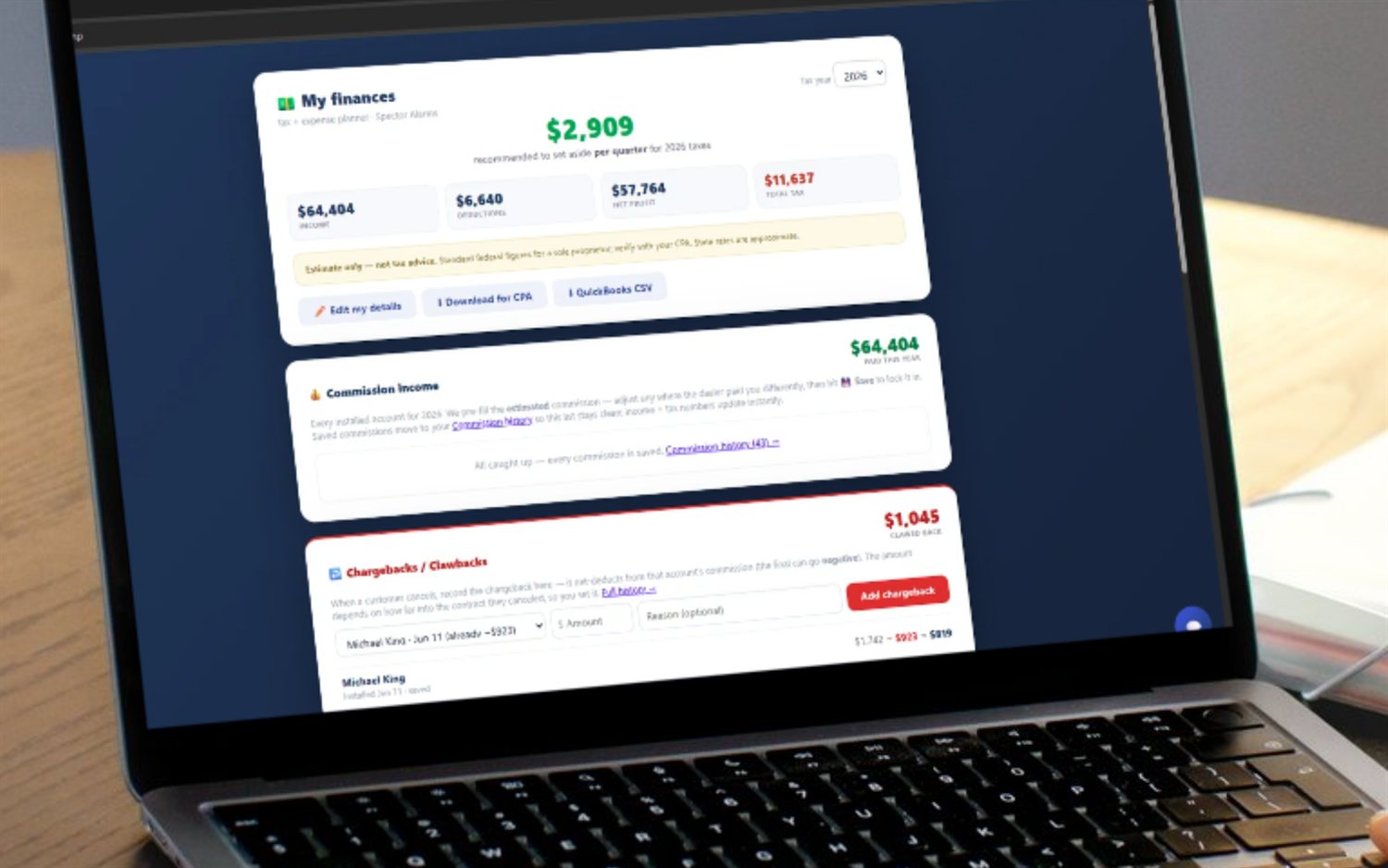
A gross-profit plan with a three-day cancel window and a delayed install is exactly the kind of comp that a notes app cannot survive. Most reps find out they were wrong about a month two months later. FieldStacker keeps the money in the same app you knock with:
The most common structure in in-home water treatment is a share of gross profit over a house base price rather than a flat percent of the ticket. The dealer sets a base for the system, you sell above it, and you are paid a percentage of the spread — a range in the neighborhood of 25 to 50 percent of gross profit is typical, though it varies a lot by dealer and by product line. Some dealers instead pay a flat 8 to 15 percent of the gross sale, and some pay a flat dollar amount per unit. Ask which of the three you are on before you take the seat, because they behave completely differently when you discount.
Almost always after install and funding, not at signature. A water treatment sale has to clear three gates first: the three-business-day cancellation window that the FTC Cooling-Off Rule gives a homeowner on most in-home sales, the lender actually funding the contract, and an install that can physically happen — drain access, a plumbing loop, electrical, sometimes a permit, sometimes an HOA. Pay cycles are commonly semi-monthly for closers and weekly for canvassers on per-set pay, but confirm the calendar with your dealer.
More than in most trades. A three-day rescission, a buyer who cancels before install, a lender declining or the contract never funding, an install that cannot be completed, a well test that comes back needing equipment nobody quoted, and in some jurisdictions a brine-discharge restriction that makes an ion-exchange softener a non-starter. If your dealer runs rentals or salt and service subscriptions, an early cancellation inside the retention window usually claws back part of that too. Get the chargeback window and the schedule in writing.
On a gross-profit plan, yes — almost entirely. If you are paid 40 percent of the spread over base and you knock 500 dollars off to close, you just handed back roughly 200 dollars of your own money, not the company's. That is the single most important thing a new water treatment rep can understand, and it is why experienced closers negotiate on terms, add-ons and financing length rather than on price. On a flat percent-of-sale plan the damage is smaller but still real.
Usually per set, sometimes with an hourly base, and often with a second payment when the appointment actually sits or closes. Per-set amounts in the range of 25 to 75 dollars are common, with a bonus on a closed deal that might be a flat 100 to 300 dollars or a point or two of the sale. The important detail is what counts as a set: a confirmed appointment, an appointment that was actually sat, or an appointment with both decision-makers present. Those three definitions produce very different paychecks from the same week of knocking.
Sometimes, and it is worth asking about specifically. Rental and lease programs, salt delivery, and filter-change or service agreements all create recurring revenue for the dealer, and some dealers share a small residual or pay a multiple of the monthly on the sale. Others keep it entirely. If a residual is offered, ask two questions: does it vest, and does it survive you leaving. An unvested residual on a rental book is not compensation, it is a retention device.
Log the deal, net the cancels, watch the miles and the tax set-aside build. 14-day free trial, no credit card, flat month-to-month.